
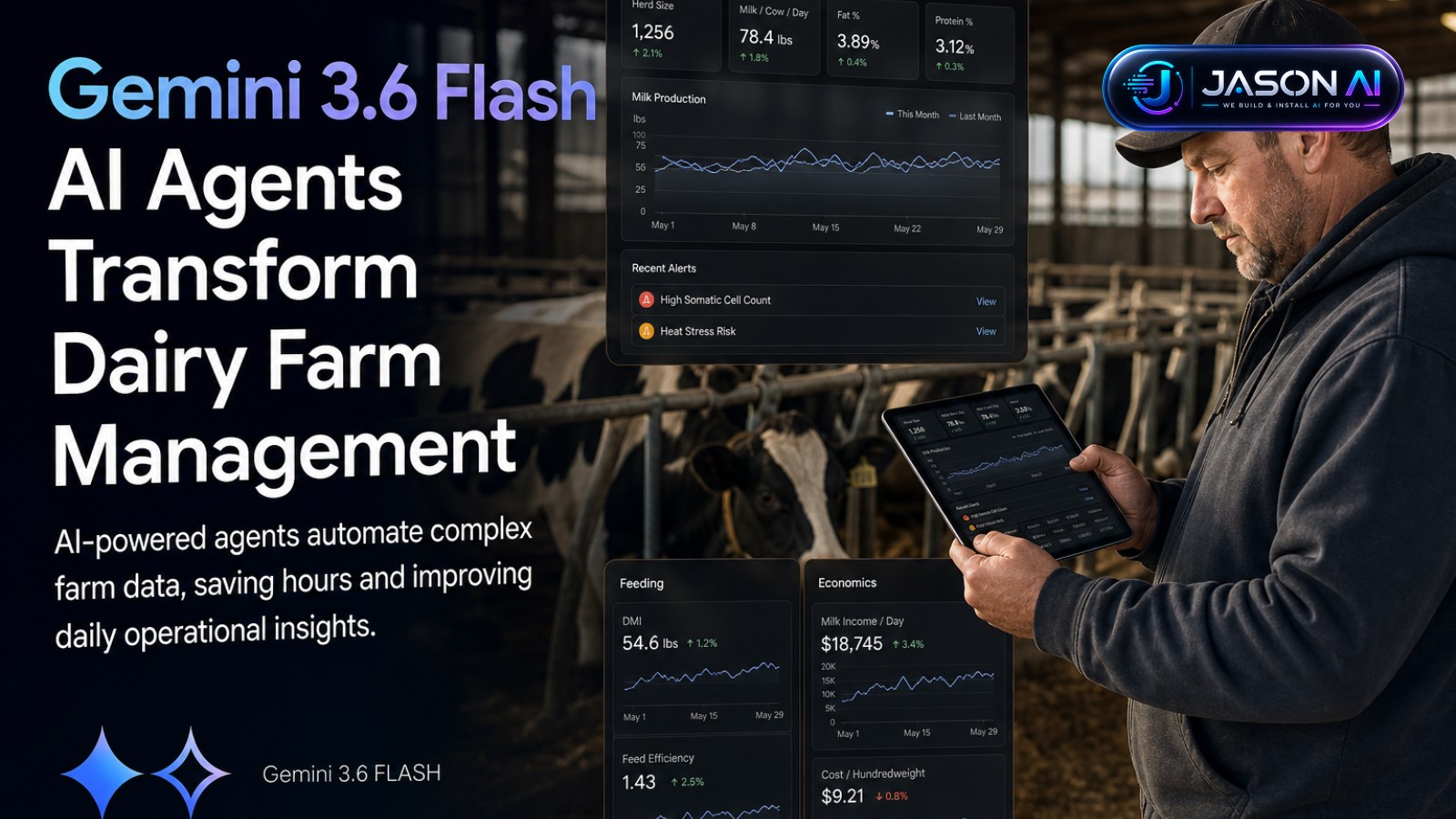
Paul Windemuller, a Michigan dairy farmer, has adopted AI agents built with Google’s Gemini 3.6 Flash to automate and streamline his farm management. By integrating siloed data from sensors, weather stations, and milk quality logs, Paul’s custom multi-agent system replaces hours of manual spreadsheet work with actionable daily reports.
Practical AI for Complex Farm Data
Dairy farming involves managing biological and environmental variables under tight financial margins. Modern farms generate vast amounts of data, but this information often exists in isolated software silos. Paul historically spent significant time merging spreadsheets each morning, limiting his ability to focus on farming tasks.
Using Gemini 3.6 Flash, Paul built a local multi-agent AI system within Google Antigravity that processes CSV files, photos of receipts, and PDFs saved to monitored folders. The system’s multimodal capabilities extract and unify visual and numeric data without relying on APIs or web scraping, keeping sensitive data local and secure.
Optimising for Reliable Metrics
The AI system calculates a key metric called Daily Static Variable Margin (SVM), which isolates biological and operational efficiency by holding market prices constant. This contrasts with traditional fluctuating metrics like Income Over Feed Cost, providing Paul with a stable basis for decision-making.
The system generates a daily “Farm CEO Briefing” summarising margin drivers and pinpointing causes of performance changes, such as heat stress. It concludes with actionable recommendations, helping Paul adjust operations efficiently.
Cost-Effective Automation for Small Farms
Gemini 3.6 Flash’s advanced reasoning and coding features, including a one million token context window and 64,000 token output, enable continuous agentic workflows at reduced cost. Benchmarking shows a 17% reduction in output tokens compared to Gemini 3.5 Flash, lowering operational expenses for small businesses like Paul’s.
Paul’s approach demonstrates how multi-agent AI systems can be tailored to specific industries and scaled affordably, empowering independent farmers to adopt similar technology to improve productivity.
Looking Ahead
While building and operating such AI tools remains a hurdle for many small farms, Paul’s system highlights a practical path for integrating AI into daily workflows. It shows the potential for AI to automate repetitive tasks and provide clear, actionable insights without compromising data privacy.
This case underscores the evolving model race in AI, where efficiency and cost-effectiveness are critical for real-world adoption beyond large enterprises.
For businesses exploring AI integration, tools like Gemini 3.6 Flash offer promising capabilities for automating complex data analysis and decision support. To learn more about practical AI adoption, visit https://jasonjuul.com.
Scope and Implementation Disclaimer: This article discusses AI automation in agricultural management based on publicly available information. Individual results may vary depending on farm size, data infrastructure, and implementation expertise. The described system is a bespoke solution and not a commercial product.