
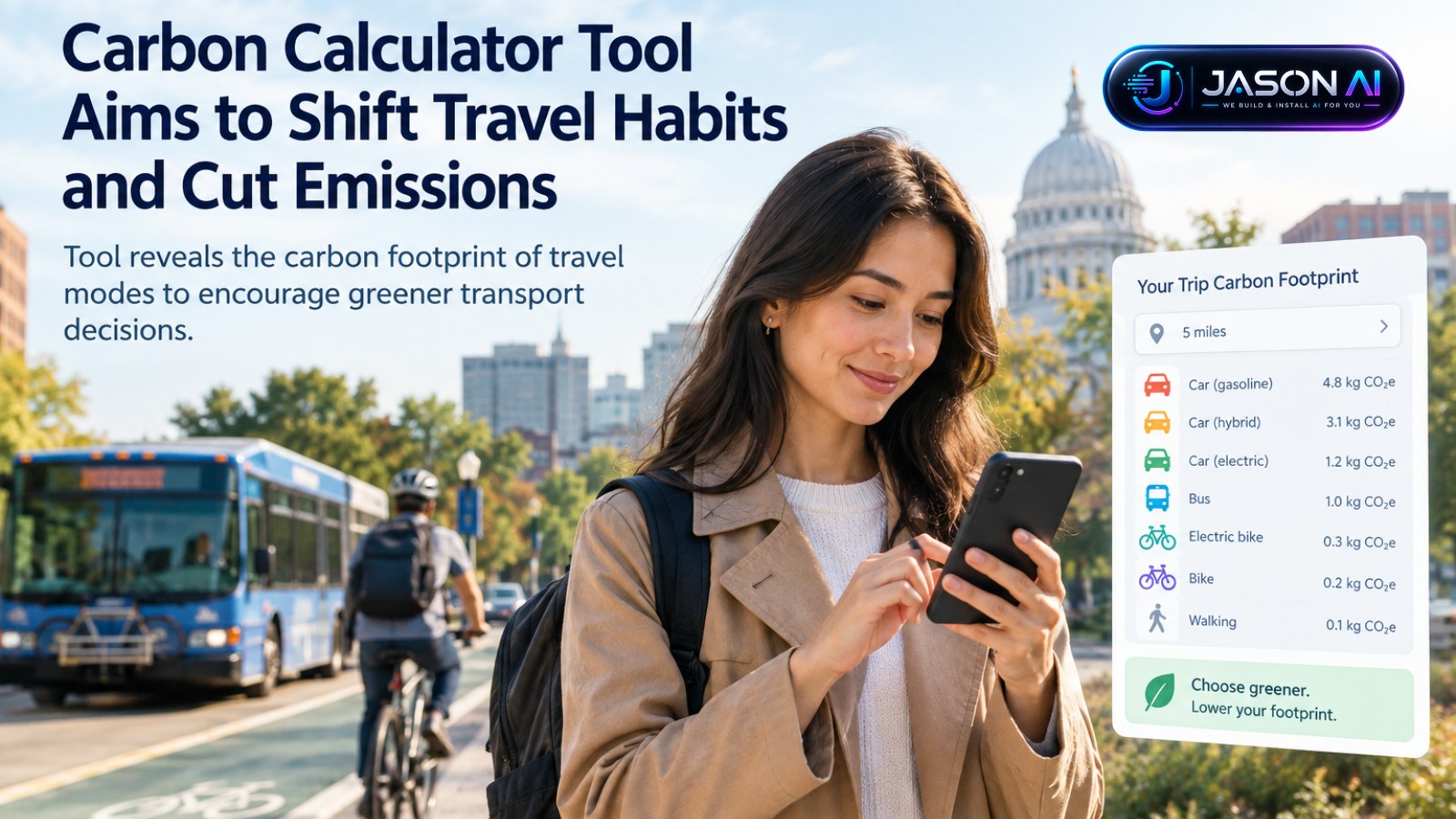
The transportation sector accounts for nearly 29% of greenhouse gas emissions in the United States, highlighting an urgent need to adopt more sustainable travel modes. A recent study from Madison, Wisconsin, introduces an innovative carbon calculator designed to inform travellers about the emissions linked to different transport options, aiming to encourage shifts towards lower-carbon choices.
How the Carbon Calculator Works
The calculator estimates the carbon footprint of a trip based on the distance travelled and a Well-to-Wheel Life Cycle Assessment (LCA). Users input their trip distance, and the tool outputs the equivalent CO2 emissions for seven modes: gasoline car, hybrid car, electric car, bus, electric bike, bike, and walking. To make the data more relatable, emissions are also expressed in terms of cheeseburger equivalents, a culturally relevant and intuitive unit for Madison residents.
This approach helps users better grasp the environmental impact of their travel choices, which is often difficult to conceptualise using standard units like kilograms of CO2 equivalent (CO2e).
Study Findings on Behaviour and Awareness
The study involved 49 participants who completed surveys before and after using the calculator. Results showed that trip distance, environmental awareness, age, income, and current mode of transport were key factors influencing whether users considered switching to lower-emission modes.
Notably, 46% of participants reported a clearer understanding of CO2e after using the tool. Furthermore, 28% improved their knowledge of the relative emissions of different transport modes, with many users surprised by emissions linked to bus travel and electric cars.
While most participants recognised that travel mode choices impact climate change, the calculator prompted mixed shifts in environmental self-identification, suggesting that awareness alone may not directly translate into behavioural change.
- Majority had access to multiple transport modes, but public transit availability was often limited
- Most participants were highly educated and environmentally conscious
- Behavioural shifts generally led to reduced CO2e emissions
Feedback indicated the cheeseburger index helped make abstract emissions data more tangible, potentially increasing engagement with sustainable travel options.
Practical Implications for Users and Businesses
For everyday travellers, this carbon calculator offers a straightforward way to compare the environmental costs of their journeys and consider alternatives like biking or electric vehicles. Businesses and urban planners can leverage such tools to promote sustainable transport policies and infrastructure by demonstrating clear emissions benefits.
By increasing transparency around travel emissions, the tool supports the broader goal of decarbonising transportation systems, a critical step in meeting climate targets.
While the study was limited by a small, demographically skewed sample and self-reported data, it provides valuable insights into how accessible environmental data can influence travel behaviour.
Explore this carbon calculator and learn more about sustainable travel at https://jasonjuul.com.
Scope and Implementation Disclaimer: This article summarises research findings without endorsing specific outcomes. Individual travel behaviour varies widely, and carbon calculators serve as educational tools rather than definitive guides. Further studies with larger, diverse populations are needed to confirm long-term behavioural impacts.