
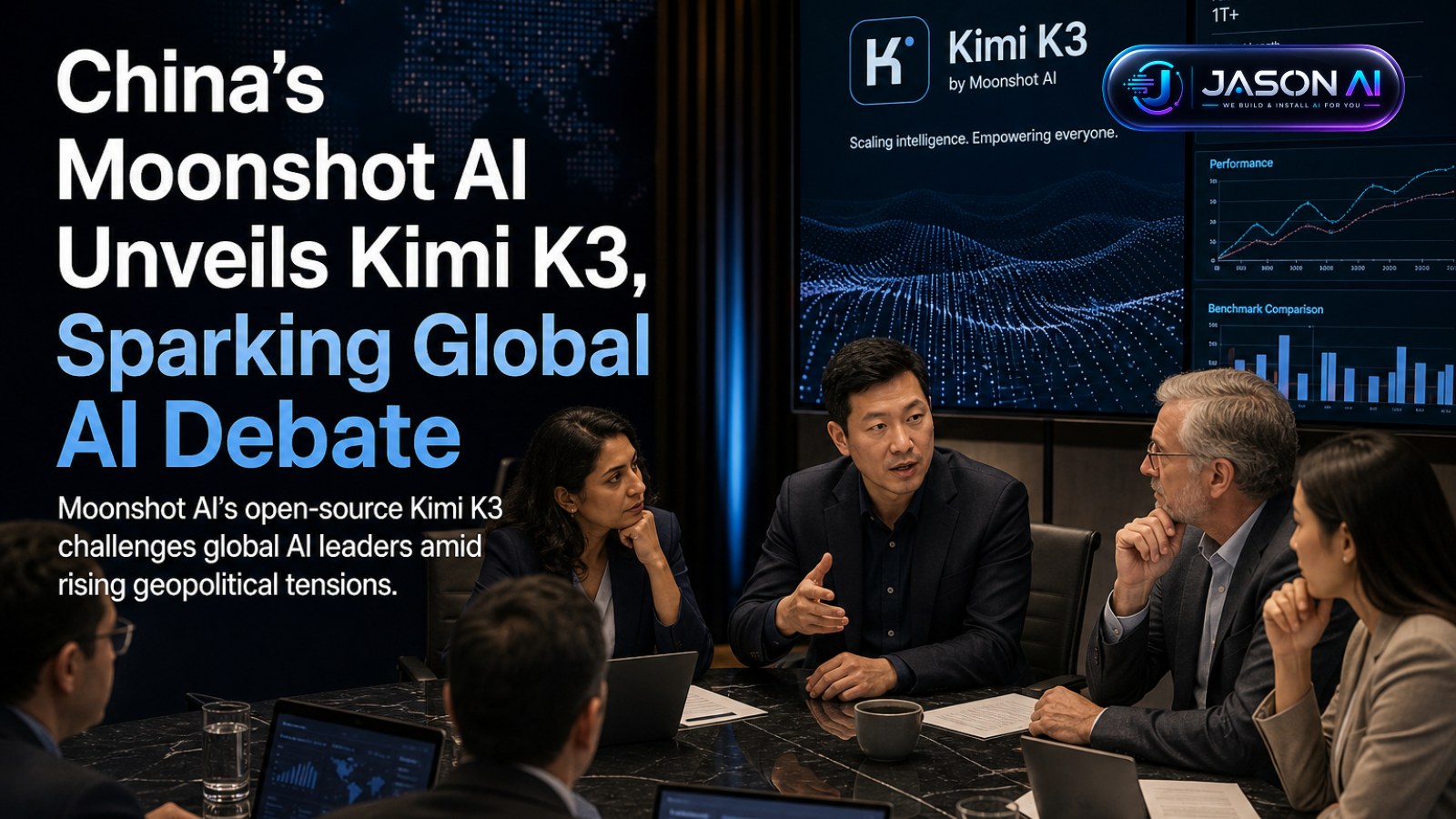
Chinese AI firm Moonshot AI recently released an updated version of its open-source language model, Kimi K3, igniting renewed debate over the global AI landscape and the implications of open-source technology originating from China. Despite trailing some leading proprietary models like Claude Fable 5 and GPT 5.6 Sol, Moonshot claims Kimi K3 outperforms many competitors in its evaluation suite. Independent assessments from Arena.ai and Vals AI support the model’s competitive standing with flagship AI systems.
Market and Political Reactions
The announcement coincided with Chinese President Xi Jinping’s address at the World AI Conference in Shanghai, triggering a notable reaction in financial markets. The Nasdaq index dropped roughly 1%, with chipmakers such as Nvidia experiencing sell-offs amid investor concerns about China’s advancing AI capabilities. This episode echoes previous tensions following the release of DeepSeek’s R1 model in early 2025, but the current geopolitical climate adds complexity due to ongoing US-China trade disputes and national security considerations.
Voices from the US Tech Sector
- David Sacks, former AI czar under the Trump administration, criticised US regulatory approaches as self-limiting, contrasting them with China’s open-source progress. He warned that excessive regulation and bureaucratic hurdles risk ceding the AI race to China.
- Ex-Uber CEO Travis Kalanick highlighted concerns over AI model “distillation,” where Chinese models are trained on outputs from American AI, calling for reciprocal access to maintain competitive balance.
- Dean Ball, OpenAI’s head of strategic futures, acknowledged Kimi as a “very good model” and expressed surprise that the Chinese government permits open sourcing of such advanced AI, given potential risks. Ball speculated that an open-weight AI model ecosystem might lead to a form of “AI communism,” where AI becomes a state-provided digital public infrastructure, a scenario he views as dystopian.
Counterpoints and Future Outlook
Shakeel Hashim, editor of the AI publication Transformer, downplayed fears around Kimi’s capabilities, suggesting the Chinese government will likely impose restrictions once models gain dangerous cyber capabilities. The debate underscores the challenges of balancing innovation, security, and regulation in a rapidly evolving AI environment.
As AI technologies continue to advance globally, companies and policymakers must carefully navigate competitive pressures alongside ethical and security concerns. For businesses exploring AI integration and automation, solutions like those from JASON AI offer practical pathways to harness AI’s potential responsibly. More information can be found at https://jasonjuul.com.
Disclaimer: This article provides an overview of AI industry developments and does not offer medical or regulatory advice. Readers should consult relevant experts before making decisions based on AI technology implementations.